



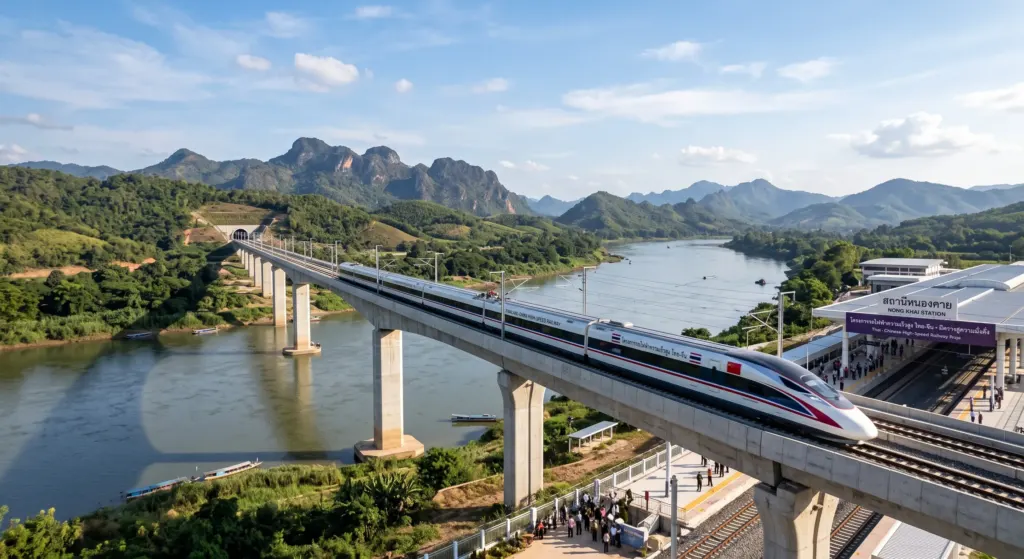
The Thai–Chinese high-speed rail (Northeastern line) is a cooperation project between the Government of the Kingdom of Thailand and the Government of the People’s Republic of China, discussed and studied jointly since 2010. It is a special mass-transit project and one of the routes in Thailand’s high-speed rail program, to be built by the State Railway of Thailand (SRT). The line aims to replace various rail services within the country, strengthen the economy’s transport capacity, and further boost domestic tourism. The Thai–Chinese high-speed rail will also connect Thailand to the Kunming–Singapore rail network (Central Route), which will link the five ASEAN countries of the Mekong region (CLMV) — Cambodia, Laos, Myanmar, Vietnam and Thailand.
Train details
The Thai–Chinese high-speed rail uses the CR300AF “Fuxing Hao” trainset, built by CRRC Changchun Railway Vehicles. The air-conditioned cars are 2.8–3.7 metres wide, 20 metres long and about 3.7 metres high, with 3–10 cars per train, carrying around 600 passengers per train and up to 50,000 passengers per hour. Top speed follows China’s high-speed rail standard: 250 km/h in service in Thailand and 350 km/h during testing. Trains are operated automatically from an operations control centre and use automatic fare collection.
Seating is divided into three classes: first class, with single seats in the car behind the driver’s cab; second class, business-type seating arranged 2-2 throughout the car; and third class, arranged 3-2 along the length of the car. Closed-system restrooms are provided on board.
Benefits for Thailand (mass transit)
- Makes travel within the country more convenient and faster
- A relatively high level of safety
- Promotes both domestic and international tourism
- Creates more jobs in Thailand during construction, as Thailand and China have agreed that all the work will be carried out by Thai labour
- Develops the areas around stations along the route, creating new commercial and investment hubs and spreading prosperity to other provinces
- Reduces congestion in cities — when public transport is fast, convenient and affordable, more people will use it
Benefits for Thailand (exports)
- Stimulates the transport system, helping Thailand become one of the region’s key transport and logistics hubs
- A wide range of container types to suit each kind of cargo
- Large volumes can be shipped at once, at a relatively lower cost than other modes of transport
- Easy to keep to schedule — weather has almost no effect on high-speed rail transport
- Lower risk of spoilage when shipping fruit or fresh goods
Route
The domestic route covers a total distance of 608 kilometres, divided into two phases.
Phase 1: Bang Sue – Nakhon Ratchasima, with 6 stations: Bangkok, Don Mueang, Phra Nakhon Si Ayutthaya, Saraburi, Pak Chong and Nakhon Ratchasima, scheduled to open in 2026.
Phase 2: Nakhon Ratchasima – Nong Khai, with 5 stations: Bua Yai, Ban Phai, Khon Kaen, Udon Thani and Nong Khai, scheduled to open in 2030.
At the end of the line, Nong Khai station will connect with the China–Laos high-speed railway, starting from the station in Lao PDR.
Additional thoughts
At first glance the high-speed rail project has many advantages for both mass transit and exports, but seen from another angle it also has a major drawback. While Thailand will be able to export goods to other countries widely, conveniently and quickly, the same is true in reverse: countries with larger populations, such as China — one of the world’s major powers with matching production capacity — will also find it much easier to export goods into Thailand. Goods made at higher volumes tend to be cheaper, which could become a long-term problem that makes life harder for small Thai businesses.
There is also the enormous cost of building high-speed rail — construction, operation and long-term maintenance; the faster the trains run, the more expensive it gets. And as an overland route, its paths are fixed and not very flexible.